
Repair or Replace Damaged Furniture? A Dubai Homeowner's Decision Guide
Not sure whether to repair or replace damaged furniture in Dubai? Compare structural damage, repair costs, replacement value and when to call a carpenter.
- 4-Question Decision Framework
- Damage Assessment Checklist
- Repair vs. Replace Decision Matrix
A loose dining chair. A cracked table leg. A wardrobe door that will not close properly. A drawer that has fallen apart. A swollen cabinet panel near the sink. These are the everyday furniture problems that leave Dubai homeowners asking the same question: "Should I repair this, or is it time to buy a new one?"
Furniture is generally a better repair candidate when the main structure remains sound and the damage is localised. Replacement may be more appropriate when major structural components or multiple panels have failed, or when a dependable repair is not practical. Every item is different, so an assessment is needed before committing either way.
Visible damage does not automatically mean the entire furniture item needs replacing. A broken drawer runner, a loose hinge, or a scratched tabletop can often be fixed without touching the rest of the piece. But a cracked load-bearing frame, extensively swollen MDF, or a joint that keeps failing after repair is a different story.
This guide gives you a clear way to assess furniture condition, understand the three available options — repair, replace a component, or replace the whole item — and compare a repair quote fairly against a genuine replacement. By the end, you will know exactly what to check and what to ask before spending money.
Nawaz Carpentry Services provides furniture repair services in Dubai for wooden furniture, cabinets, wardrobes, and built-in units. We wrote this guide to help you make a sensible decision — whether you choose to repair with us or replace elsewhere.
Table of Contents
- Repair or Replace? Start With These Four Questions
- When Is Furniture Worth Repairing?
- When Is Replacing Furniture the Better Option?
- Furniture Damage Assessment: What to Check
- Repair, Replace a Component, or Replace Everything?
- Furniture Repair vs Replacement: Decision Matrix
- Is It Cheaper to Repair Furniture or Buy New?
- Examples for Common Household Furniture
- How to Prepare for a Repair Assessment
- Frequently Asked Questions
Repair or Replace Furniture? Start With These Four Questions
Before you get a quote or start browsing for a replacement, work through these four questions. They will tell you more about your furniture's real condition than any price list.
Question 1: Is the Main Structure Still Sound?
The frame is the skeleton of your furniture — the legs, rails, supports, and main joints that carry weight and hold everything together. If the frame is sound, most other problems are fixable. If the frame is compromised, even a beautiful-looking piece may not be worth saving.
Check:
- Do the legs wobble or feel loose?
- Do the joints separate when you apply gentle pressure?
- Are there cracks around screws or fixings?
- Does the furniture feel stable when used normally?
Sound frame = good repair candidate. Compromised frame = consider replacement.
Question 2: Is the Damage Localised or Widespread?
A single loose hinge or one damaged panel is very different from multiple cracked, swollen, or failing components spread across the piece.
| Damage Pattern | What It Usually Means | Typical Best Path |
|---|---|---|
| One loose hinge | Isolated hardware issue | Repair |
| One damaged drawer runner | Component failure | Replace Component |
| One swollen cabinet panel | Localised moisture damage | Replace Component |
| Multiple swollen panels | Widespread moisture problem | Replace Item |
| Cracked frame + loose joints | Structural failure | Replace Item |
Question 3: Can the Damaged Part Be Repaired or Replaced Separately?
This is where many homeowners over-spend. A broken drawer runner, a damaged hinge, a cracked handle, or a single warped door does not require replacing the entire wardrobe or cabinet.
Ask: "Can I fix or swap just this one part?" If yes, you have a component-replacement option — often the most cost-effective middle ground.
Question 4: Is the Repair Sensible Compared With Equivalent Replacement?
Once you know what needs fixing, compare a written repair quotation against the cost of a genuinely comparable replacement — same dimensions, similar material quality, similar finish, plus delivery and assembly.
Important: Do not use a rigid rule like "repair if it costs less than 50% of replacement." That may be a useful starting prompt, but it is not a reliable universal decision rule. A AED 500 repair on a AED 2,000 wardrobe is very different from a AED 500 repair on a AED 800 flat-pack unit.
Answered the Four Questions but Still Unsure?
Send us photos of the damage and we'll help you identify which of the three paths makes most sense for your furniture.
When Is Furniture Worth Repairing?
Repair makes sense when the problem is limited, the surrounding structure is sound, and the repair will produce a dependable result. Here are the most common repair-friendly situations.
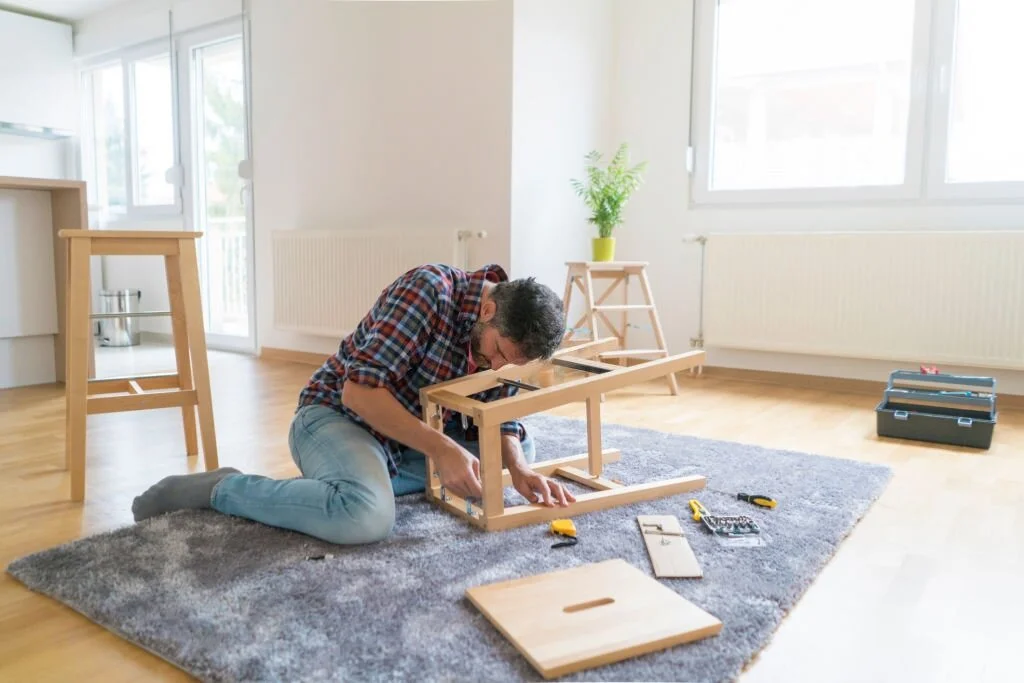
A loose joint on a sound frame is one of the most common — and most repairable — furniture problems.
Minor Surface Damage
Scratches, small dents, worn finishes, and limited cosmetic damage can often be improved with refinishing or localised repair — when the underlying material is sound.
For example, a dining table with surface scratches but a solid, stable frame is a classic refinishing candidate. The scratches are cosmetic; the structure is fine.
Loose Joints and Fixings
Loose joints, hinges, handles, and drawer fittings can often be repaired or replaced without replacing the entire item. A wobbly chair leg, a sagging cabinet door, or a drawer that sticks can usually be sorted with re-gluing, reinforcement, or hardware replacement.
But the surrounding material must be checked. If the wood around the joint is cracked, split, or deteriorated, simply re-gluing will not hold. The repair needs to address the material condition, not just the loose joint.
A Damaged Component With a Sound Main Structure
This is where component replacement shines. A damaged wardrobe door, a broken drawer runner, a cracked cabinet panel, or a damaged table leg can often be replaced individually — leaving the rest of the furniture untouched.
Example: A wardrobe with one warped door but a perfectly good carcass, shelves, and other doors is a strong component-replacement candidate. Making one new door to match is far more practical than replacing the entire wardrobe.
Custom-Sized or Matching Furniture
If your furniture fits an unusual space — a built-in wardrobe in an awkward alcove, a cabinet sized for a specific wall, or a piece that matches an existing set — replacement becomes harder and more expensive. Custom-sized furniture is often worth assessing for repair before giving up on it.
Furniture With Personal or Sentimental Value
A piece with sentimental value — a family heirloom, a gift, or a custom-made item — may be worth repairing even when the economics are marginal. But structural safety and realistic repair limitations still matter. Sentimental value does not make unsafe furniture safe to use.
Rule of thumb: Repair is worth exploring when the damage is localised, the structure is sound, and the repair will produce a dependable, lasting result — not just a temporary cosmetic fix.
When Is Replacing Furniture the Better Option?
Repair is not always the right answer. Sometimes replacement is genuinely the more practical, safer, and more economical choice. Here is when to consider it.
Severe Structural Damage
Cracked load-bearing frames, extensively split supports, unstable legs, and joints that cannot be reliably restored are clear signs that replacement deserves serious consideration.
Safety note: Do not put weight on unstable furniture, test a damaged chair by sitting on it, or continue using a bed with compromised support. Serious instability needs professional assessment before further use.
Extensive Water or Moisture Damage
Swollen engineered-wood panels, delamination (where the layers separate), crumbling edges, or widespread material deterioration limit repair options significantly.
Why MDF and particleboard struggle with water: These engineered materials absorb moisture and swell. Once swollen, they lose structural integrity and will not hold screws or glue reliably. A swollen panel cannot simply be "dried out and re-used" — it usually needs replacing.
Important: The moisture source must also be addressed before replacement components are installed. Otherwise, the new panel will swell too.
Swollen or delaminated engineered-wood panels usually cannot be reliably repaired — component or full replacement is often more practical.
Repeated Failure After Previous Repairs
If the same joint, drawer, or panel has failed two or three times despite repairs, this usually signals an underlying construction or material problem — not bad luck.
For example, a drawer runner that keeps breaking may indicate the drawer box is too heavy for the runner grade, or the cabinet carcass is out of alignment. Repairing the runner again without fixing the cause will just lead to another failure.
Repair Scope Approaches the Cost of a Suitable Replacement
Compare the full repair scope — including parts, labour, collection/delivery, and any finishing — against a replacement of similar size, material quality, functionality, and finish. Not the cheapest flat-pack alternative.
If a repair quote is approaching the price of a genuinely comparable new piece, replacement often makes more sense — especially if the new item comes with a warranty.
The Furniture No Longer Meets Your Needs
Sometimes the furniture is fine — but your life has changed. A wardrobe that was perfect for one person may be inadequate for a family. A dining table for four may not suit a household of six. A TV unit designed for a small screen may not accommodate a larger one.
Important: Replacement should be based on condition and suitability, not age alone. A well-made 15-year-old wardrobe in good condition may be worth keeping; a poorly-made 2-year-old flat-pack unit with failing joints may not be.
Decision shortcut: If you answered "no" to two or more of the four questions in the framework above, replacement deserves serious consideration.
Think Your Furniture May Be Beyond Repair?
Send us photos and we'll give you an honest assessment — including whether repair, component replacement, or replacement makes most sense.
Furniture Damage Assessment: What Should You Check?
A proper assessment looks beyond the visible damage to understand why it happened and whether the surrounding structure can support a repair. Here is a practical inspection sequence you can follow before calling a carpenter.
Step 1: Check Joints, Frames and Support Points
A carpenter will typically inspect:
- Loose or separating joints — where two pieces of wood meet.
- Cracks around screws and fixings — a sign the material is failing.
- Movement in legs and rails — gently test for wobble.
- Warping or misalignment — does the piece sit level?
- Overall stability — does the furniture remain safe for its intended use?
Step 2: Inspect Panels, Edges and Surfaces
Look closely at the visible surfaces and edges:
- Swelling or bubbling — a sign of moisture damage in engineered wood.
- Peeling laminate or veneer — the surface layer is separating from the substrate.
- Broken corners and edges — impact damage that may be repairable.
- Cracked or missing sections — structural or cosmetic depending on location.
- Water staining vs. deeper deterioration — a stain may be cosmetic; swelling and delamination are structural.
Plain-language definitions:
Carcass = the main box structure of a cabinet or wardrobe.
Veneer = a thin layer of real wood glued onto a cheaper substrate.
Delamination = when the layers of engineered wood separate.
Structural joint = a joint that carries weight or holds the frame together.
Step 3: Identify Whether Hardware Is the Real Problem
Sometimes what looks like furniture damage is actually a hardware failure. A door that will not close may have a bent hinge, not a warped door. A drawer that sticks may have a worn runner, not a damaged box.
Check:
- Are the hinges bent, loose, or rusted?
- Do the drawer runners slide smoothly, or are they worn?
- Are handles and fixings tight?
- Is the sliding door track clean and aligned?
Hardware-only problems are the cheapest to fix — and often the most commonly misdiagnosed.
Step 4: Consider Previous Repairs
Ask yourself: Has this same part failed before? If yes, the earlier repair may not have addressed the underlying cause.
For example, a chair leg that was re-glued six months ago and is now loose again suggests the joint geometry or the wood condition is the real problem — not just the glue.
Safety reminder: Never test a damaged chair by sitting on it, put weight on an unstable table, or continue using a bed with compromised support. Serious instability needs professional assessment before further use.
Done Your Own Assessment?
Send us your findings — photos of the damage, joints, and hardware — and we'll help you interpret what you're seeing.
Repair, Replace a Component, or Replace the Whole Item?
Most homeowners think there are only two options — repair or replace. But there is a third, often the most cost-effective: replace just the damaged component.
Three Paths for Damaged Furniture
Choose based on the extent of damage and the condition of the surrounding structure
Option 1: Repair
Fix the existing damage — re-glue a joint, adjust a hinge, refinish a surface, or reinforce a loose connection.
Best when: Damage is minor & structure is soundOption 2: Replace Component
Make or fit a new door, panel, leg, drawer front, or fitting — leaving the rest of the furniture untouched.
Best when: One part failed, rest is goodOption 3: Replace Item
Replace the entire furniture piece when damage is widespread, structural, or repeated.
Best when: Multiple failures or structural damageOption 1: Repair the Existing Furniture
Repair is suitable to assess when the problem is limited and the surrounding structure is sound. Common repair methods include:
- Joint repair: Re-gluing and clamping a loose joint, sometimes with reinforcement.
- Hinge adjustment: Tightening, realigning, or replacing hinges.
- Refinishing: Sanding and re-applying a finish to restore a worn surface.
- Localised damage repair: Filling small dents, repairing minor chips, or touching up scratches.
Best for: Minor, isolated problems on otherwise sound furniture.
Option 2: Replace the Damaged Component
This is the middle path — and often the smartest one. A new door, panel, leg, drawer front, or fitting can be made or sourced to match the rest of the furniture.
Examples:
- A warped wardrobe door replaced with a new matching door.
- A swollen cabinet panel near the sink cut out and replaced.
- A broken table leg remade to match the original dimensions and finish.
- A worn drawer runner replaced with a new, higher-grade runner.
What makes this work: The replacement component must match the original in dimensions, material, edging, and finish. A good carpenter can fabricate a matching piece; a poor one will leave you with a visible mismatch.
Best for: One component has failed, but the rest of the furniture is in good condition.
Option 3: Replace the Entire Furniture Item
When damage is widespread, structural, or repeated despite repairs, replacing the whole item is often more practical.
Signs this is the right path:
- Multiple panels or joints have failed.
- The frame is cracked or unstable.
- Water damage is extensive.
- The same problem keeps recurring.
- Repair cost approaches the cost of a comparable replacement.
Best for: Widespread damage, structural failure, or furniture that no longer meets your needs.
Quick decision test: Ask yourself — "If I fix this one problem, will the rest of the furniture last another 5+ years?" If yes → repair or component replacement. If no → replacement.
Furniture Repair vs Replacement: Decision Matrix
This is the core reference table of this guide. Use it to match your specific damage type to the most likely best path.
| Damage or Condition | Repair May Be Suitable When | Replacement May Be Better When | Most Likely Path |
|---|---|---|---|
| Loose joint | Joint and surrounding material remain sound | Multiple joints or frame sections have failed | Repair |
| Broken leg | Damage is localised and a reliable repair is possible | Main support structure is severely compromised | Component |
| Scratched surface | Damage is cosmetic and finish can be restored | Extensive damage makes refinishing impractical | Repair |
| Damaged wardrobe door | Door or hardware can be repaired or remade | The cabinet structure is also badly damaged | Component |
| Swollen panel | Damage is limited and a suitable replacement component is possible | Multiple panels have deteriorated or lost integrity | Component |
| Broken drawer | Runner, front, or drawer box can be repaired or replaced | The cabinet carcass is extensively damaged | Component |
| Repeated repair | Previous fault has a clear, correctable cause | The same structural failure continues | Replace |
| Water damage | Surface damage only and material remains sound | Swelling, delamination, or deterioration is extensive | Replace |
Important: These are assessment guidelines, not remote diagnoses. A carpenter should verify the actual condition before recommending a repair method. Photos help, but they cannot show concealed damage inside a joint or behind a panel.
Found Your Damage Type in the Matrix?
Send us photos matching your situation and we'll confirm which path makes most sense for your specific piece.
Is It Cheaper to Repair Furniture or Buy New?
This is the question everyone wants a simple answer to — but the honest answer is: it depends on what you are comparing. A repair quote and a replacement quote are only comparable if they cover the same scope.
What Should a Furniture Repair Quote Include?
A complete repair quotation should state:
- Inspection or assessment charge, if any
- Labour and the specific repair method
- Replacement components or hardware needed
- Material and finish matching
- Workshop work, if the item needs to be collected
- Collection and delivery, if applicable
- Any limitations or warranty terms
What Should You Include When Comparing a New Item?
A fair replacement comparison includes:
- Comparable dimensions to your existing piece
- Similar material and construction quality
- Matching design and finish
- Equivalent storage and functionality
- Delivery, assembly, and installation
- Any disposal arrangement for the old furniture
Why the Cheapest Replacement Is Not Always a Fair Comparison
A low-cost new item may not match your original furniture's construction, dimensions, quality, or fit. A AED 800 flat-pack wardrobe is not a fair replacement for a custom-built, solid-wood wardrobe that fits a specific alcove perfectly.
When comparing, ask: "Would this new item actually serve me as well as my repaired existing piece?" If the answer is no, the price comparison is meaningless.
Comparison rule: Compare like with like. A repair quote for a custom-built wardrobe should be compared against a custom-built replacement — not a flat-pack alternative from a furniture store.
Have a Repair Quote and a Replacement Price?
Send both to us and we'll help you understand whether they're genuinely comparable — or whether you're comparing apples to oranges.
Repair or Replace? Examples for Common Household Furniture
Different furniture types fail in different ways. Here is how the decision framework applies to the most common household items.
Wardrobes and Built-In Cabinets
Wardrobes and built-in cabinets are among the most common repair candidates in Dubai homes — especially in apartments where the wardrobe is fitted to a specific alcove.
Common problems:
- Loose or misaligned hinges.
- Worn or broken sliding door tracks.
- Doors that will not close or align properly.
- Worn or broken drawer runners.
- Swollen or damaged panels near the floor.
Decision guide: If the carcass is sound and only one door, track, or runner has failed → component replacement. If multiple panels are swollen or the carcass is damaged → consider replacement. For a full wardrobe replacement, see our custom wardrobes in Dubai page.
Wooden Beds and Bed Frames
Beds take more daily stress than almost any other furniture. Loose joints, broken slats, damaged rails, and worn centre supports are common.
Safety first: A bed with a compromised centre support or cracked side rails should not be used until assessed. The weight distributed across a bed means a "small" crack can fail suddenly.
Decision guide: A broken slat or loose joint on a sound frame → repair. A cracked side rail or failed centre support → component replacement or full frame assessment.
Dining Tables and Chairs
Dining furniture takes daily use, and problems usually show up as loose joints, unstable legs, surface scratches, or cracked supports.
Common repairs:
- Re-gluing loose chair legs or table joints.
- Refinishing scratched tabletops.
- Reinforcing wobbly legs.
- Replacing a cracked table leg.
Decision guide: Surface scratches on a sound table → refinishing. A wobbly chair with sound joints → re-glue and reinforce. A cracked table leg with a damaged frame → assess carefully; may need component replacement.
TV Units, Shelves and Storage Furniture
Wall-mounted units, bookcases, and storage furniture have their own failure patterns — usually related to fixings, weight, and panel integrity.
Common problems:
- Sagging shelves under heavy loads.
- Loose wall fixings.
- Damaged panels from impact or moisture.
- Worn drawer runners in media units.
Decision guide: A sagging shelf on a sound unit → reinforce or replace the shelf. Loose wall fixings → re-anchor properly. Multiple damaged panels → assess the whole unit.
Remember: These examples reflect common wooden and built-in furniture repairs. Upholstery, metalwork, and specialist restoration are separate services — confirm what your carpenter actually offers.
How to Prepare for a Furniture Repair Assessment in Dubai
The more useful information you provide upfront, the more accurate the initial assessment will be. Here is exactly what to prepare:
What to Send
- One full photo of the furniture item, showing its overall condition.
- Close-up photos of the damaged area from 2–3 angles.
- Photos of joints, panels, and fixings if visible — especially around the damage.
- Approximate dimensions — width, height, and depth.
- When the problem started and whether it has been repaired before.
- Material if known — solid wood, MDF, plywood, etc.
- Your Dubai community or location — helps plan a site visit if needed.
A carpenter inspecting damaged furniture — photos help with the initial review, but an in-person check may be needed for structural assessment.
What Photos Can and Cannot Tell Us
Photos can show:
- Visible surface damage.
- Obvious joint separation.
- Panel swelling or delamination.
- Hardware condition.
- Overall furniture type and style.
Photos cannot show:
- Concealed damage inside a joint.
- The true condition of material behind a panel.
- Whether a repair will be structurally reliable.
- Hidden moisture damage.
- The exact dimensions needed for a replacement component.
Important: Photos help with an initial review but may not reveal concealed damage or establish whether a repair is structurally reliable. An in-person inspection may be needed for a final, dependable assessment.
Ready to Send Your Photos?
Follow the checklist above, take your photos, and send them via WhatsApp — we'll review and advise on the next step.
Frequently Asked Questions About Furniture Repair vs Replacement
It depends on the structural condition, repair feasibility, the cost of a suitable replacement, and the furniture's intended use. Furniture is generally a better repair candidate when the main structure remains sound and the damage is localised.
Check the frame, joints, panels, hardware, and extent of damage. If the main structure is sound and the damage is limited to one component or surface, repair is often worth assessing. A professional assessment may be needed when structural condition is uncertain.
Minor surface issues and severely swollen panels are different situations. Swollen or delaminated MDF may not hold fixings reliably, and component replacement or whole-item replacement may be more practical.
A joint may be repairable when the surrounding material is sound. Cracked or deteriorated material can make a simple re-gluing approach unsuitable, and reinforcement or component replacement may be needed.
This may be possible if a compatible panel can be fabricated and the remaining structure is suitable. Dimensions, material, edging, and finish matching all matter.
Photographs and approximate measurements can help with an initial assessment, but a final quotation may require an inspection, especially when structural condition or concealed damage is uncertain.
Not Sure Whether Your Furniture Is Worth Repairing?
Send us photos of the damage, approximate measurements, and your Dubai community through WhatsApp or our contact form. We can discuss the issue and advise on the next assessment step — whether that's repair, component replacement, or a replacement recommendation.