
Sliding vs Hinged Wardrobes: Clearance, Storage and Maintenance
Compare sliding vs hinged wardrobes for bedroom clearance, storage access and maintenance. Find the right wardrobe door style for your room — based on your actual layout, not generic rules.
- Room Clearance Diagrams
- Storage Access Comparison
- Maintenance Checklists
Sliding wardrobes are useful when outward door movement would obstruct the bedroom, while hinged wardrobes are useful when you want wider access to the wardrobe interior. The right choice depends on your measured room clearance, storage layout, and daily use — not on a universal rule.
You are probably here because you are planning a new fitted wardrobe or replacing existing wardrobe doors, and you have hit the same question every Dubai homeowner faces: "Will sliding doors actually work in my bedroom, or do I need hinged doors?"
The answer is not "sliding is always better for small rooms" or "hinged is always better for storage." Both statements are oversimplifications. The truth is more nuanced: the best wardrobe door is the one that fits your bedroom's actual layout and lets you reach your clothes, drawers, and shelves comfortably every day.
This guide breaks down the real trade-offs — clearance, access, storage layout, and maintenance — with practical diagrams you can use to plan your own room. By the end, you will know exactly what to measure and which questions to ask before approving a wardrobe design.
Nawaz Carpentry Services designs and installs custom wardrobes in Dubai for apartments, villas, and family homes. We wrote this guide to help you make an informed door-system choice — whether you eventually choose us or another provider.
| Decision Factor | Sliding Wardrobes | Hinged Wardrobes |
|---|---|---|
| Front Clearance | No outward door swing; standing and access space still needed | Needs clear space for the door to swing open |
| Interior Access | Panels overlap; only part of the wardrobe accessible at a time | Doors can open together to reveal more of the interior |
| Drawer Placement | Must account for panel overlap and opening positions | Generally more flexible; doors open away from the cabinet |
| Track / Hardware | Uses tracks, rollers, and guides | Uses hinges and related fittings |
| Maintenance | Keep tracks clear; check rollers, guides, and alignment | Check hinge screws, alignment, and smooth closing |
| Room Suitability | Useful where a bed or walkway is close to the wardrobe | Useful where the room has enough space for door movement |
| Design Options | Works well with broad panels; mirror or glass finishes possible | Flexible door widths, panel styles, and finishes |
| Main Planning Concern | Panel overlap, track space, and access to internal sections | Door swing, nearby furniture, and opening angles |
Table of Contents
- What Is the Difference Between Sliding and Hinged Wardrobes?
- Main Advantages and Disadvantages
- How Much Clearance Do Wardrobe Doors Need?
- Which Wardrobe Type Gives Better Storage Access?
- Sliding vs Hinged Wardrobe Maintenance
- Which Wardrobe Is Better for Different Bedroom Layouts?
- How to Choose the Right Wardrobe Door Type
- Frequently Asked Questions
What Is the Difference Between Sliding and Hinged Wardrobes?
Before comparing advantages and disadvantages, it helps to understand exactly how each system works — because the mechanics explain most of the trade-offs.
How Sliding Wardrobe Doors Work
Sliding wardrobe doors move horizontally along tracks mounted at the top and bottom of the wardrobe opening. Each panel runs on rollers or glides, and panels overlap as they move — meaning one panel slides in front of another.
This overlap is the defining feature of sliding systems. It is what allows the doors to save floor space (no swing needed), but it is also what limits access — at any given moment, part of the wardrobe interior is always covered by an overlapping panel.
Key components:
- Top track: Guides the top of each panel.
- Bottom guide/track: Keeps the bottom of the panel aligned.
- Rollers or glides: Allow smooth horizontal movement.
- Overlapping panels: Two or more panels that slide past each other.
- Soft-close mechanism (optional): Cushions the panel as it closes.
How Hinged Wardrobe Doors Work
Hinged wardrobe doors rotate outward from the wardrobe frame on hinges — like a cupboard door. When open, the door swings into the room, requiring clear floor space in front of the wardrobe.
Key components:
- Hinges: Connect the door to the carcass frame.
- Door panels: Individual doors that open independently.
- Handles or knobs: For gripping and pulling the door open.
- Soft-close hinges (optional): Cushion the door as it closes.
The key difference: hinged doors need swing space; sliding doors need track space but no swing. This single mechanical difference drives most of the practical trade-offs.
Both systems can be used in fitted and custom wardrobes. The choice depends on three factors: clearance, accessibility, and maintenance — which we'll cover in detail below.
Sliding vs Hinged Wardrobes: Main Advantages and Disadvantages
Hinged Wardrobes
Advantages:
- Multiple doors can open to reveal more of the wardrobe at once.
- Internal drawers, shelves, and hanging sections are easier to reach.
- Door hardware is straightforward to inspect and adjust.
- Individual door panels open without moving another panel.
Disadvantages:
- Doors need room to swing outward.
- Open doors can conflict with beds, bedside tables, or other furniture.
- Door handles and open panels can obstruct narrow circulation routes.
Key insight: Neither system is "better" in absolute terms. Sliding wins on space efficiency; hinged wins on access convenience. Your bedroom layout determines which trade-off matters more to you.
Still Torn Between the Two?
Send us a photo of your bedroom layout and we'll help you see which door system fits your space best.
How Much Clearance Do Wardrobe Doors Need?
This is the most practical section of this guide — because clearance is where most wardrobe planning mistakes happen. Getting this wrong means a door that hits the bed, a drawer that cannot open, or a wardrobe you cannot comfortably use.
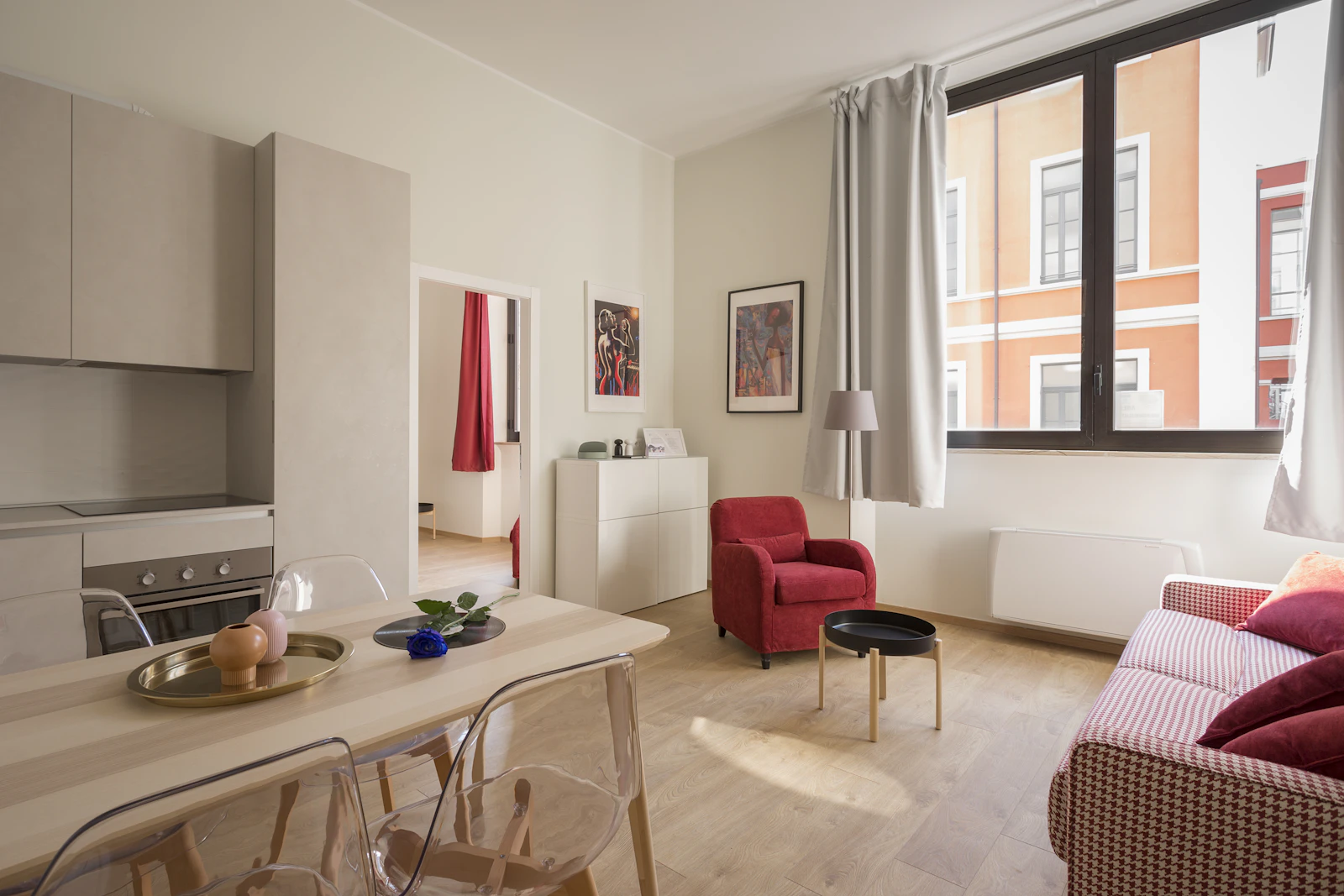
A bedroom layout with the wardrobe, bed, and bedside tables in place — the starting point for any clearance check.
Hinged Doors: The Swing Arc
Hinged wardrobe doors need enough room to open without hitting nearby furniture, walls, or the room door. The door swings in an arc — and the wider the door, the bigger the arc.
A door that "technically clears" the bed may still leave an uncomfortable place to stand and reach for clothes. You need space for both the open door and your body standing in front of it.
Room Clearance: Hinged vs Sliding
Same bedroom layout, two different door systems — illustrative planning aid, not a substitute for site measurement
Hinged Doors — Swing Arc
Sliding Doors — Panel Positions
Sliding Doors: No Swing, But Still Need Standing Room
Sliding doors avoid the outward swing, but users still need space to stand comfortably and access the open section. You cannot eliminate the need for floor space entirely — you just change what that space is used for.
With sliding doors, check:
- Can you stand comfortably in front of the open section?
- Can you reach the hanging rail or shelf without stretching?
- Can a drawer pull out fully without hitting the opposite panel or bed?
How to Measure Your Own Room
Follow this simple method before choosing a door system:
- Measure the available wall width for the wardrobe.
- Measure the proposed wardrobe depth (typically 550–650mm for hanging space).
- Measure from the wardrobe front to the nearest obstacle — bed edge, bedside table, or wall.
- Mark the hinged door's opening arc on a simple floor plan (use a string or pencil tied to the hinge point to draw the arc).
- For sliding doors, draw the panel positions and mark which wardrobe sections remain covered when a panel moves.
- Check drawer clearance — can each drawer open fully without hitting the opposite panel or bed?
Important: This diagram is a planning aid, not a substitute for the selected hardware manufacturer's fitting dimensions or a site measurement. Door width, hinge type, and track system all affect the real clearance needed.
Which Wardrobe Type Gives Better Storage and Accessibility?
Having storage and being able to reach it comfortably are two different things. A wardrobe can have plenty of shelves and drawers — but if the door system blocks access to them, the storage is wasted.

Sliding wardrobe doors with panel overlap — notice how one panel covers part of the interior at any given time.
The Hidden Access Trade-Off: Panel Overlap
This is the trade-off most generic articles skip. With sliding doors, panels overlap — meaning when you slide one panel to access a section, another panel moves to cover a different section.
Sliding Panel Overlap & Access
How panel position affects which wardrobe sections you can reach
Hanging Rail
DrawersCOVERED
Shelves
What This Means for Your Internal Layout
The panel overlap affects different storage types differently:
| Storage Type | Sliding Doors | Hinged Doors |
|---|---|---|
| Hanging sections | Can reach the exposed section; covered section needs panel movement | Can open multiple doors for wider access |
| Drawers | Drawer must not sit behind a permanently covered panel; check opening clearance | Generally more flexible; doors open away from drawers |
| Shelves | Frequently used items should be in an easily exposed section | Can access multiple shelves at once |
| Shared wardrobes | Each user accesses their own section; panels may conflict | Two people can access different sections simultaneously |
| Corner or narrow layouts | Panel movement may be restricted by room shape | Door swing may be restricted by walls |
Practical Access Test
Before approving a design, run this simple test on your floor plan:
- Pick 2–3 items you use together daily (e.g., a shirt and the drawer with accessories).
- On the plan, move the door/panel to reach each item in sequence.
- Notice: does reaching one item require closing off another section you also need?
- If yes, reconsider the internal layout or door system.
For a shared wardrobe, run the same test for both users. Separate daily-use sections may be more useful than a perfectly symmetrical internal arrangement.
Design principle: The internal wardrobe design can matter as much as the door type. A well-planned sliding wardrobe with smart compartment placement can outperform a poorly-planned hinged wardrobe — and vice versa.
Want Help Planning Your Internal Layout?
Send us your storage wish list (drawers, hanging, shelves, shoe storage) and we'll help design a layout that works with your chosen door system.
Sliding vs Hinged Wardrobe Maintenance
Both door systems need some maintenance, but the type and frequency differ. Understanding this upfront helps you choose a system that matches your willingness to maintain it.
Sliding wardrobe track and roller mechanism — the components that need periodic cleaning and inspection.
Maintaining Sliding Wardrobe Doors
Sliding systems rely on tracks, rollers, and guides — all of which collect dust and debris over time.
Maintenance checklist:
- Keep tracks free of dust and loose debris.
- Check that rollers move smoothly without grinding.
- Look for panels that scrape, wobble, or move unevenly.
- Check guides and track fixings are tight.
- Avoid forcing a panel that has become difficult to move.
- Clean tracks periodically with a vacuum or damp cloth.
If a door becomes difficult to move: Do not force it. The cause may be a loose fitting, misalignment, or debris in the track — forcing it can damage the rollers or track. Stop and inspect, or call a professional.
Maintaining Hinged Wardrobe Doors
Hinged systems rely on hinges and fittings — generally simpler to inspect and adjust.
Maintenance checklist:
- Check for loose hinge screws periodically.
- Look for doors that sag or no longer align properly.
- Check that doors open and close without rubbing the frame.
- Inspect handles and soft-close fittings, where installed.
- Avoid hanging heavy items from wardrobe doors.
- Tighten hinge screws if a door starts to drop.
Maintenance Comparison at a Glance
| Aspect | Sliding Doors | Hinged Doors |
|---|---|---|
| Primary components | Tracks, rollers, guides | Hinges, screws, fittings |
| Main maintenance task | Track cleaning and roller check | Hinge screw tightening |
| Common failure | Sticking, scraping, uneven movement | Sagging, misalignment, rubbing |
| DIY difficulty | Moderate — track alignment can be tricky | Easy — hinge adjustment is straightforward |
| Frequency | Every 3–6 months (cleaning) | Every 6–12 months (check screws) |
Practical note: If a door becomes difficult to move — whether sliding or hinged — avoid forcing it. The cause may be a loose fitting, misalignment, or damaged hardware that needs inspection. Forcing a stuck mechanism usually makes the problem worse.
Which Wardrobe Is Better for Different Bedroom Layouts?
There is no universal "best" door type — the right choice depends on your specific bedroom layout. Here are realistic scenarios based on common Dubai apartment and villa configurations.
Larger Bedroom
Hinged doors may be practical when there is enough opening clearance. Full access to the interior makes daily use more convenient.
Watch for: Door swing conflicting with bedside tables or the room door.
Wardrobe Beside a Bed
Draw the hinged door swing and check for collisions with the bed or bedside table. A door that technically clears may still leave an awkward standing position.
Watch for: Narrow gaps between wardrobe and bed; sliding may be safer here.
Shared Bedroom
Consider whether both users need access to different wardrobe sections at the same time. Hinged doors allow simultaneous access; sliding panels may conflict.
Watch for: Panel positions that block one user while the other is accessing their section.
Local relevance: Dubai apartment bedrooms often have fixed dimensions and limited circulation space, making sliding doors a frequent practical choice. Villa bedrooms with more space may suit hinged doors better — but the specific room layout always decides.
Which Layout Matches Your Bedroom?
Send us a photo or sketch of your bedroom layout and we'll recommend the door system that fits your specific space.
How to Choose the Right Wardrobe Door Type Before Installation
Before approving a wardrobe design, work through this practical checklist. It takes 15 minutes and can save weeks of frustration later.
Pre-Installation Checklist
- Measure the bedroom and wardrobe wall (width, height, depth).
- Mark the bed, bedside tables, and other nearby furniture on a simple floor plan.
- Check the available space in front of the wardrobe for door swing or standing access.
- Decide which drawers and hanging sections need frequent access.
- Confirm the sliding track or hinge specifications with your carpenter.
- Check door-panel dimensions and finish options.
- Review the internal layout before approving the final design.
- Test the "morning routine" — can you reach your daily items without frustration?
Final check before signing: Ask your carpenter to show you the proposed door system operating — either in a showroom sample or as a detailed diagram. Notice where the handle sits, how the door starts moving, and what happens as it closes. This is the best way to avoid surprises.
Questions to Ask Your Carpenter
- "What is the exact clearance needed for this door system in my room?"
- "Which internal sections will be covered when a sliding panel moves?"
- "Can all my drawers open fully with this door configuration?"
- "What hardware brand and model are you specifying, and why?"
- "What maintenance will this system need, and how often?"
- "What happens if the track or hinge needs adjustment after a year?"
Frequently Asked Questions
Neither is universally better. Sliding wardrobes suit rooms where outward door swing would obstruct furniture or walkways, while hinged wardrobes suit rooms with enough clearance and homeowners who want wider simultaneous access to the interior.
Sliding doors are often useful in small bedrooms because they do not need outward swing space. However, the user still needs standing and access space, and panel overlap can restrict access to parts of the interior.
Hinged doors need enough clear space in front of the wardrobe for the door to swing open without hitting the bed, bedside table, wall, or room door. The required space depends on door width, hinge type, and opening angle — there is no single universal clearance number.
Not all at once. Sliding panels overlap, so only part of the wardrobe interior is exposed at any one time. This affects access to drawers, shelves, and hanging sections behind the covered panel.
Generally, yes. Hinged systems use hinges and fittings that are straightforward to inspect and adjust. Sliding systems rely on tracks and rollers that need periodic cleaning and alignment checks.
Yes. Dust and debris in the track can cause panels to stick, scrape, or move unevenly. Regular cleaning of the track and checking roller condition helps maintain smooth operation.
Yes, but drawer placement must account for panel overlap and opening positions. A drawer behind a covered panel cannot be accessed until that panel is moved.
Feasibility depends on the existing wardrobe construction, dimensions, track support, and condition. Not every existing wardrobe can be converted — an assessment is needed to determine whether the carcass can support a sliding system.
Need Help Choosing Custom Wardrobe Doors in Dubai?
The right choice depends on your bedroom layout, wardrobe dimensions, nearby furniture, and intended storage arrangement. Send your photos, rough measurements, and Dubai community via WhatsApp or our contact form — Nawaz Carpentry Services can discuss whether a sliding or hinged arrangement is more suitable for your proposed wardrobe.